Active Trans and the Riders for Better Transit campaign want to meet you! We’re hosting a social so that we can get together and share our love for transit.
Please join us for this evening of fun and get to know others who want to make transit better in our region.
Riders for Better Transit Social
Tuesday, February 7
6:00pm-8:00pm
Blue Frog’s Local 22 (22 E. Hubbard, near Grand station on the Red Line )
Special guests Greg Borzo and Tracy Swartz will share some insights on Chicago transit. Greg Borzo is author of The Chicago "L", a popular book that covers the complete history of Chicago’s greatest working antique and biggest “mover & shaker.” Tracy Swartz authors the RedEye Chicago column “Going Public” and just recently completed a journey riding every one of Chicago’s 139 bus routes.
The event is free and open to the public; no RSVP necessary. Light snacks provided; cash bar available. Please email any questions about this event to Brenna@activetrans.org.
See you soon!
Congress is currently debating our federal transportation programs and spending, and the way things are going, the impacts to transit riders could be disastrous. This week, a committee of the House of Representatives released the text of a bill (H.R.3864) that would effectively transfer all funding from the federal Mass Transit Account—and put it into the Highway Account. This move would destroy a dedicated revenue source for transit, established by President Reagan thirty years ago, and jeopardize $5 billion annually for the nation’s transit systems. Some are calling it a declaration of war on transit.
This means transit agencies nationwide would have to fight for general funds every year. For 2012, RTA was planning to get approximately 12% of its total budget from federal sources, and CTA alone usually gets about $250 million per year. CTA uses this money for capital projects like station rehab, track improvement, and new cleaner buses and trains. Loss of this funding could put the brakes on all sorts of maintenance and expansion projects throughout the region, and it could translate into significant service cuts, fare increases, or both.
The outlook in this bill for funding walking and biking projects is similarly bleak.
Congress will be acting on this bill immediately. Tell your Representative to vote against this bill, and that this is exactly the wrong direction for our nation’s transportation.
We need to invest in a transportation system with transit, walking and biking as an integral part. This bill instead represents a doubling down on highways and abandonment of transit riders and communities.
Last night the Streets for Cycling 2020 Plan held its third public input meeting and it was a huge success. More than 100 people showed up and provided project planners with that local knowledge that only local residents could provide. Thanks to everyone who came out and who has been a part of the public process thus far. There is still plenty of opportunity to get involved and Active Trans is proud and grateful to be a part of this historic process. Learn more at www.chicagobikes.org.
|
|
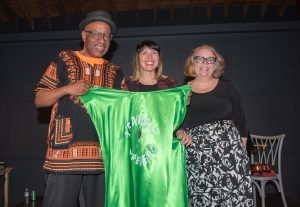
Pictured with Pautsch (center) are Shafaq Choudry (Active Trans),
Ron Burke, (Active Trans' Executive Director), Pautsch, Richard Bascomb (Village of Schaumburg), Dan Persky (Active Trans), and Barb Cornew (Active Trans). |
Last week trail advocates and residents in Chicago Heights celebrated the long-awaited progress in the development of Old Plank Road Trail. The 22-mile paved trail is located about 30 miles south of Chicago, and connects the towns of Joilet, New Lenox, Frankfort, Matteson, Richton Park, Park Forest and Chicago Heights.
Initial construction on Old Plank Road Trail began in 1997; the trail constitutes a small but significant portion of the larger Grand Illinois Trail, which runs a total of 500 miles through Northern Illinois.
Over the past decade, advocates worked relentlessly to ensure a 0.8-mile section that passes through Chicago Heights would come to completion as a functional portion of the larger Illinois trail network. Opposition towards the trail stemmed from worries that the trail would lead to a spike in criminal activity, due to its location in a historically underserved community. However, many residents and advocates hope that the trail will have the reverse effect; it will increase foot traffic and improve the community as new environmental and sustainable projects – such as community gardens and farmers markets – develop as a result.
Old Plank Road Trail prohibits motorized vehicles, but allows pedestrians, cyclists, skaters, and leashed animals. For more information and a full history of the trail, visit OPRT.org.
Do you live Illinois’s 14th Congressional District represented by U.S. House of Rep. Randy Hultgren?
If so, please consider contacting him today to urge him to preserve funding for walking and biking.
The long-awaited federal transportation bill, unfortunately, eliminates the two largest programs that fund biking and walking — Transportation Enhancements and Safe Routes to School.
Rep. Hultgren sits on the House of Representative’s Committee on Transportation and Infrastructure and can help prevent a potential disaster for active transportation throughout the nation.
Please contact him today to urge him to preserve funding for walking and biking. Constituents may call Rep. Hultgren at (202) 225-2976.
We expect a full floor vote will happen around Feb. 13, but our best hope is to get this changed while it's in committee.
Thank you!
West Town Bikes, located on Paseo Boricua (the stretch of Division street centered between Western and California avenues), in Chicago's Humboldt Park neighborhood has long been known as a go-to resource for those looking for lessons in bicycle mechanics.
Their youth education programs, coupled with adult classes in the evenings, and a thriving storefront bicycle retail operation (Ciclo Urbano) have made West Town a center for promoting bicycle culture on Chicago's West side.
Recently, some of the program participants in West Town's youth education programs took their show on the road when five members of West Town's Girls Bike Club made the trek to January's second annual Youth Bike Summit hosted by Recycle-A-Bicycle in New York City.
The five teenage members of Girls Bike Club (Joceliz Arnaud, Tania Castillo, Shacora Hawkins, Ladijah Hollingsworth and Kayla Story) chaperoned by West Town’s Program Manager Liz Clarkson gave a presentation to some of the other 275 attendees from 20 other states about their one-of-a-kind club.
This club, along with West Town Bike's popular Women and Trans Open Shop Nights, both serve as shining examples of the fantastic work being done to expand the accessibility of bicycling as transportation to what many have designated the "indicator species"--namely women.
Programs like these, popular blogs on cycling with women in mind like "Let's Go Ride a Bike" (written by Chicago lawyer Dottie Brackett), women-specific rides such as the monthly Women who Bike brunch rides (also organised by Brackett), as well as expanding trends in cycling clothing and style that appeal to female riders are all part of a movement that brings cycling more and more into the mainstream.
There are even bicycle bags and accessories produced by local Chicago companies like Po Campo that are designed with women riders in mind.
So kudos again to West Town Girls Bike Club and your recent trip to the Big Apple. We hope that you inspired other young women to experience the empowerment that occurs with independent transportation choices like bicycling. We'll be on the lookout for girls bike clubs to be popping up all over!
The Wheaton City Council will vote in February on adopting the new Wheaton Bicycle Plan. Wheaton city staff and Active Trans presented the proposed plan to city council on January 23.
During the past two years Wheaton officials have been gathering input for the plan from various city and county agencies, as well as local residents.
Last week's meeting gave residents and city council members an opportunity to comment and ask questions about the final version of the plan. One resident noted the importance of neighborhood/school connections and another raised questions about motorized bicycles. Overall, the plan was favorably received.
In response to a council inquiry, city staff identified route signage, bicycle route maps and bicycle racks as three of the top priorities set out by the plan.
Active Trans assisted Wheaton with obtaining Congestion and Air Quality Mitigation grants totaling $225,000 for these projects. The city can begin implementing their new plan soon after adoption.
Governor Quinn and the Illinois Department of Transportation announced the recipients of the long-awaited Safe Routes to School grant awards this week.
An amount of $21.7 million was divvied up among communities large and small, with funds going toward constructing new sidewalks, installing traffic calming strategies, organizing walking school buses, hosting bike rodeos, and more. All of these initiatives will contribute to safer and healthier environments for kids in grades K-12.
Many communities in northeastern Illinois will benefit from the grants, including unincorporated Des Plaines, West Chicago, University Park, Blue Island, Bridgeview, Crystal Lake, Woodstock, North Aurora, and South Elgin.
Active Trans provided technical assistance to several communities that applied for a Safe Routes to School grant during this round of funding. In total, we helped Illinois’ communities secure over $2.1 million in infrastructure funds and more than $200,000 in non-infrastructure funds.
To view a complete list of the awards, visit Illinois’ Safe Routes to School webpage.
Congratulations to all of the communities that received awards.
A new grassroots initiative, City of Big Shovels, focuses on safe and productive snow shoveling for all Chicago residents and neighborhoods. City of Big Shovels provides Chicagoans with helpful resources, legal information regarding snow removal, as well as a chance for readers to submit their own photos.
|
|
| Image courtesy of City of Big Shovels. |
City of Big Shovel’s slogan, “every sidewalk clear,” reminds Chicagoans that residential sidewalks, and those surrounding private businesses, are required by law to be shoveled in a timely manner.
Winter’s treacherous weather poses difficulties for all pedestrians, but snowy sidewalks are a particular hazard for the elderly and people with disabilities. To help those in need, the City of Chicago just launched Snow Corps, a program that connects volunteers with Chicagoans who require snow removal help.
For more information regarding City of Big Shovels and snow shoveling in 2012, check out our recent Modeshift article.
Also, check out Tribune columnist Mary Schmich's article about City of Big Shovels and its founder, Ben Helphand (who also happens to be a member of the Active Trans Board of Directors.)
Lastly, keep in mind the hazards that snow shoveling can pose – check out City of Big Shovel’s smart shoveling tips.
Copyright © 2011 Active Transportation Alliance | All Rights Reserved | Privacy policy
Recent comments
12 min 23 sec ago
2 hours 42 min ago
1 day 6 hours ago
1 day 10 hours ago
2 days 31 min ago
2 days 3 hours ago
3 days 1 hour ago
3 days 16 hours ago
2 weeks 22 hours ago
2 weeks 1 day ago